
Barajas hits record passenger numbers: how to read the figures and what they mean
Every few months there is talk of a new passenger record at Barajas. We explain how those figures are measured, why summer brings the peaks and how they affect you when you travel.
Published on 31 October 2014 Updated on 1 November 2026 5 min read
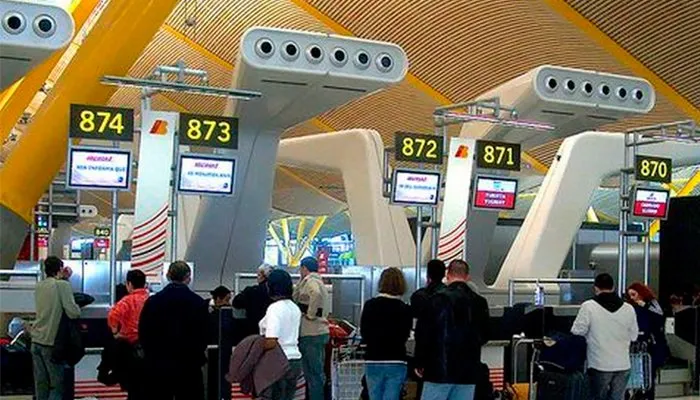
When a passenger record is announced at Barajas, it usually means the airport has beaten its best figure for that month or for a full year, according to the official statistics published by Aena. Barajas is the busiest airport in Spain, ahead of Barcelona-El Prat, and its figures move with the economy, tourism and the season: the summer months always bring the year's peaks and the winter months the lows. For travellers, a record month means busier terminals, more queues and more demand for transport.
This kind of news comes up regularly, and the percentages change every month. Rather than remembering a particular figure, it is more useful to know how to interpret them.
How an airport's figures are measured
Aena publishes statistics for all its airports every month, with three main indicators:
- Passengers: every person who boards or gets off a plane. A return trip counts as two, and so does a connection.
- Movements: every take-off and every landing.
- Cargo: tonnes of air freight.
The data are broken down into domestic and international traffic and compared with the same period the previous year. If you want to know what that means day to day, in how many passengers pass through Barajas each day we turn the annual figures into a daily average.
Monthly record, annual record and year-on-year growth
It is worth distinguishing three expressions that get mixed up in headlines:
| Expression | What it means | How to read it |
|---|---|---|
| Monthly record | The best figure ever for that particular month | A July with more passengers than any previous July |
| Annual record | The best full year in the airport's history | Twelve months that beat the previous best year |
| Year-on-year growth | Change compared with the same period the previous year | A month that grows compared with the same month last year, even if it is not a record |
| “The best figure in X months” | The highest figure for some time, without being an all-time record | Common during recovery phases after a crisis |
Why summer always brings the peaks
Traffic at Barajas is highly seasonal. July and August bring together school holidays, international tourism and Spaniards travelling to the coast, the islands and abroad. Easter, long weekends and Christmas produce shorter but intense peaks. At the other end of the scale, the middle weeks of January and February are usually the quietest.
That is why it makes no sense to compare August with November: valid comparisons are between the same month in different years. And that is also why records tend to be announced in summer. If you are wondering where all those passengers are travelling to, we discuss it in Spaniards' favourite destinations.
Crisis and recovery
Air traffic is very sensitive to the economic situation. The major crises of recent decades, from the economic recession to the pandemic, brought passenger numbers down sharply, and the recovery took time. It is in those phases that you see the most headlines of the “best figure in so many months” kind: they are not all-time records, but signs that traffic is growing again.
Barajas and El Prat
Madrid-Barajas and Barcelona-El Prat are the country's two big airports and tend to move in parallel, with Barajas in the lead. The difference lies in their profile: Barajas carries more weight as a connection centre, especially with Latin America, a role we explain in Barajas as an international hub.
Beyond the airport
Behind every record there is economic activity: direct employment at the airport and with the airlines, and indirect employment in hotels, retail, restaurants and transport. As taxi drivers we notice it straight away: more flights mean more travellers who need to get to the terminal or back home.
What a packed airport means for your transfer
On the busiest days, the airport approach roads and the taxi ranks at arrivals face heavy demand. The way to avoid surprises is to sort out your transfer in good time: book your airport taxi with a set pickup time and, on the way back, a terminal pickup with your flight number. We work with a fixed fare by zone, with no traffic surcharges: from inside the M-30, €33 to any terminal.
In summer, when more families and groups travel together, the 7-seater taxi lets you all go in a single vehicle with your luggage. And if you are leaving from outside the capital, we also cover the towns of the Madrid region.
High season at Barajas: book in good time
Secure your airport taxi at a fixed price by zone with a 24-hour service, in summer and on long weekends too.
Fixed fares
Airport taxi from your area
- Interior M-30 €33
- Torrejón de Ardoz €30
- Alcobendas €33
- San Sebastián de los Reyes Pueblo €33
- Alcalá de Henares €53
- Getafe €53
- Leganés €53
- Majadahonda €53
- Las Rozas de Madrid €58
- Móstoles €63
- Alcorcón €63
- Fuenlabrada €63
Need a taxi to the airport?
Instant fixed price. No sign-up.
- Journey
- When
- Your details
We can't find it on the list.
Call or message us and we'll give you a price straight away.
Terminal · Madrid-Barajas
Your fixed price
Passengers
Suitcases
Your fixed price
Booking received!
We'll confirm your booking by phone shortly. If it's for less than 2 hours from now, please call us directly.
Reference
Your fixed price