A brief history of Madrid-Barajas Airport: from 1929 to T4 and the Adolfo Suárez name
From an aerodrome with a small terminal in the 1930s to one of Europe's major airports: the key stages in Barajas's history and how the way of getting there has changed.
Published on 12 December 2019 Updated on 1 November 2026 7 min read

The history of Barajas Airport begins in 1929, when land in the former municipality of Barajas, north-east of Madrid, was chosen to build the capital's civil airport. It opened to traffic in the early 1930s with a small terminal designed by the architect Luis Gutiérrez Soto, grew during the second half of the 20th century with new runways and the terminals we now call T1, T2 and T3, and opened T4 in 2006. Since 2014 its official name has been Adolfo Suárez Madrid-Barajas Airport, in honour of the first prime minister of Spain's democracy.
Here are its main stages at a glance. Below we tell the story in more detail, along with how something very practical has changed: how you get to the airport.
| Stage | What defines it |
|---|---|
| 1929 | Land at Barajas is chosen for Madrid's civil airport |
| Early 1930s | Opens to traffic with a modest terminal by Luis Gutiérrez Soto |
| Civil War | Military use and civil activity suspended |
| Post-war years | Runways paved and extended, commercial flights resume |
| Second half of the 20th century | Jet aircraft, mass tourism and growth of terminals T1, T2 and T3 |
| Late 20th century and 2006 | Plan Barajas: new runways and construction of T4 and its satellite |
| 2014 | Current name in honour of Adolfo Suárez |
The origins: a civil airport for the capital
In the 1920s Madrid did not have a civil airport as such. Flights were spread between aerodromes of military origin, such as Getafe or Cuatro Vientos, which is considered the oldest in Spain and is now used for general aviation. Barajas is not, in fact, the only aerodrome in the region; we explain this in how many airports there are in Madrid.
Commercial aviation was starting to grow and the capital needed a facility designed for passengers. In 1929 a flat area next to the village of Barajas, with good road links, was chosen. The airport opened in the early 1930s with modest facilities: a small terminal with rationalist lines, the work of Luis Gutiérrez Soto, some hangars and an airfield that had little in common with today's runways. Regular commercial flights began shortly afterwards.
War, the post-war years and the leap to a major airport
During the Civil War the airport was put to military use and civil activity was suspended. When the conflict ended, flights resumed and work began that would turn it into a real airport: the runways were paved and lengthened for ever larger aircraft and the site was enlarged.
In the middle of the century the municipality of Barajas was absorbed into Madrid, so the airport came to lie within the capital's boundaries, where it remains today as part of the district that bears its name.
Jets, tourism and terminals T1, T2 and T3
The arrival of jet aircraft and the boom in tourism in Spain transformed Barajas in the decades that followed. Traffic grew faster than the facilities and the airport went through an almost continuous series of building works: longer runways, new aprons and new buildings. That is how the continuous complex of terminals T1, T2 and T3 took shape, built and refurbished in different stages and still in use.
At the same time, Madrid was establishing itself as a connection hub between Europe and Latin America, a role that explains much of the airport's later growth.
The Plan Barajas and the arrival of T4
By the end of the 20th century the airport was nearing its capacity limit, and the so-called Plan Barajas was launched, the largest expansion in its history. It included new runways, up to the current four arranged in two parallel pairs, and a separate terminal building: T4, with its satellite T4S, opened in 2006.
T4 changed the image of Barajas. Its undulating roof of bamboo slats and the colour gradient of its structure have made it one of the icons of contemporary Madrid architecture. The design by Richard Rogers's practice and Estudio Lamela won the Royal Institute of British Architects' Stirling Prize that same year. The main building and the T4S satellite are linked by an underground train. If you are interested in the airport's lesser-known details, we cover them in curiosities of Madrid airport.
For travellers, the practical consequence is that Barajas has two large separate areas: T1-T2-T3 on one side and T4-T4S on the other. Going to the wrong terminal can cost you quite a while, so it is worth checking before you set off with our guide on which Barajas terminal you need.
The name: from Barajas to Adolfo Suárez
The airport took its name from the old village of Barajas, and that is how everyone knew it for more than eighty years. In 2014, after the death of Adolfo Suárez, the first prime minister of Spain's democracy, it was officially renamed Adolfo Suárez Madrid-Barajas Airport. In everyday conversation, however, most people still just say Barajas.
Almost a century after its beginnings, it is the airport with the most passenger traffic in Spain and Madrid's only commercial air gateway, with four terminals in two areas and a key role in the region's tourism and economy.
How the way of getting to the airport has changed
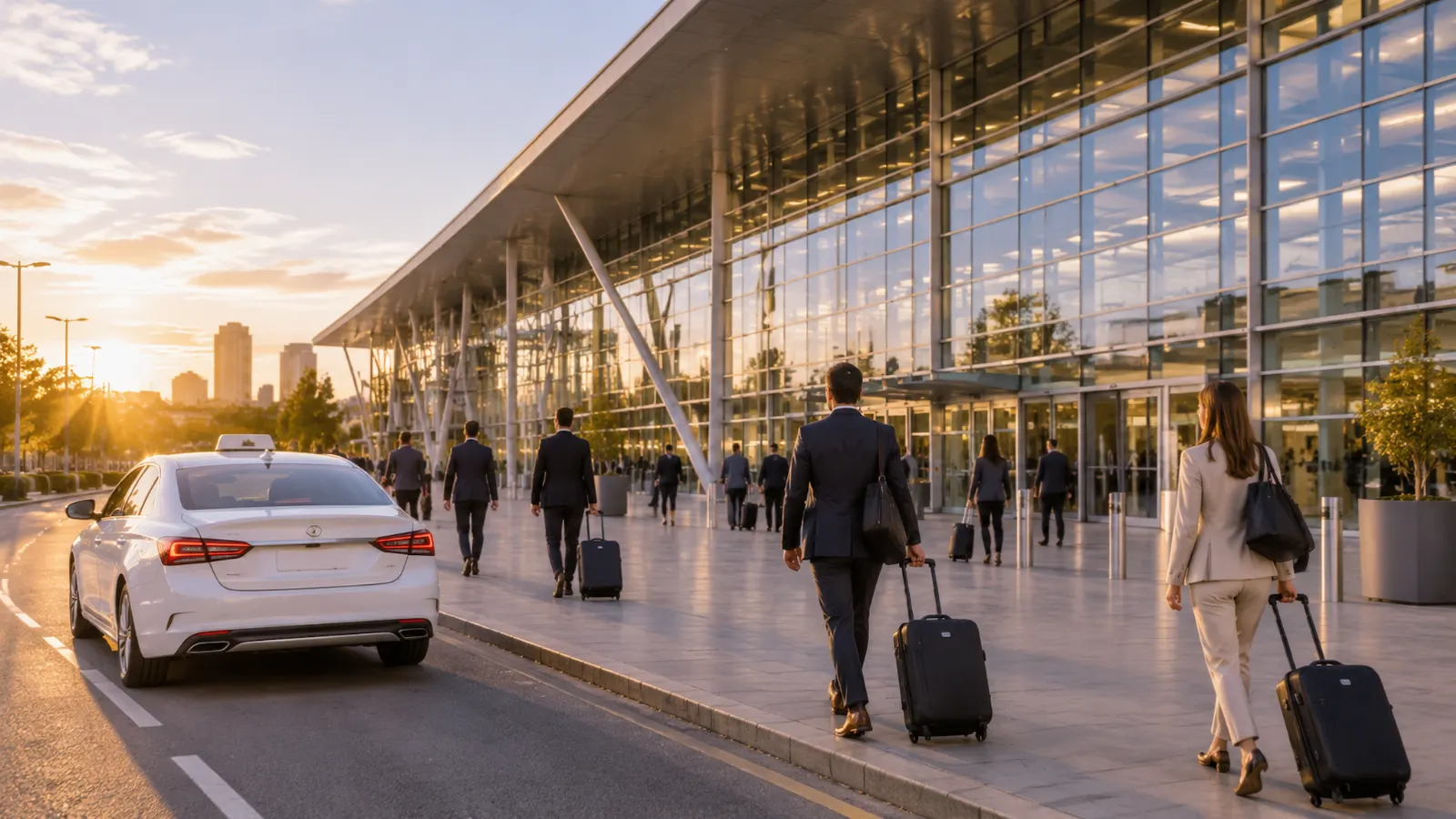
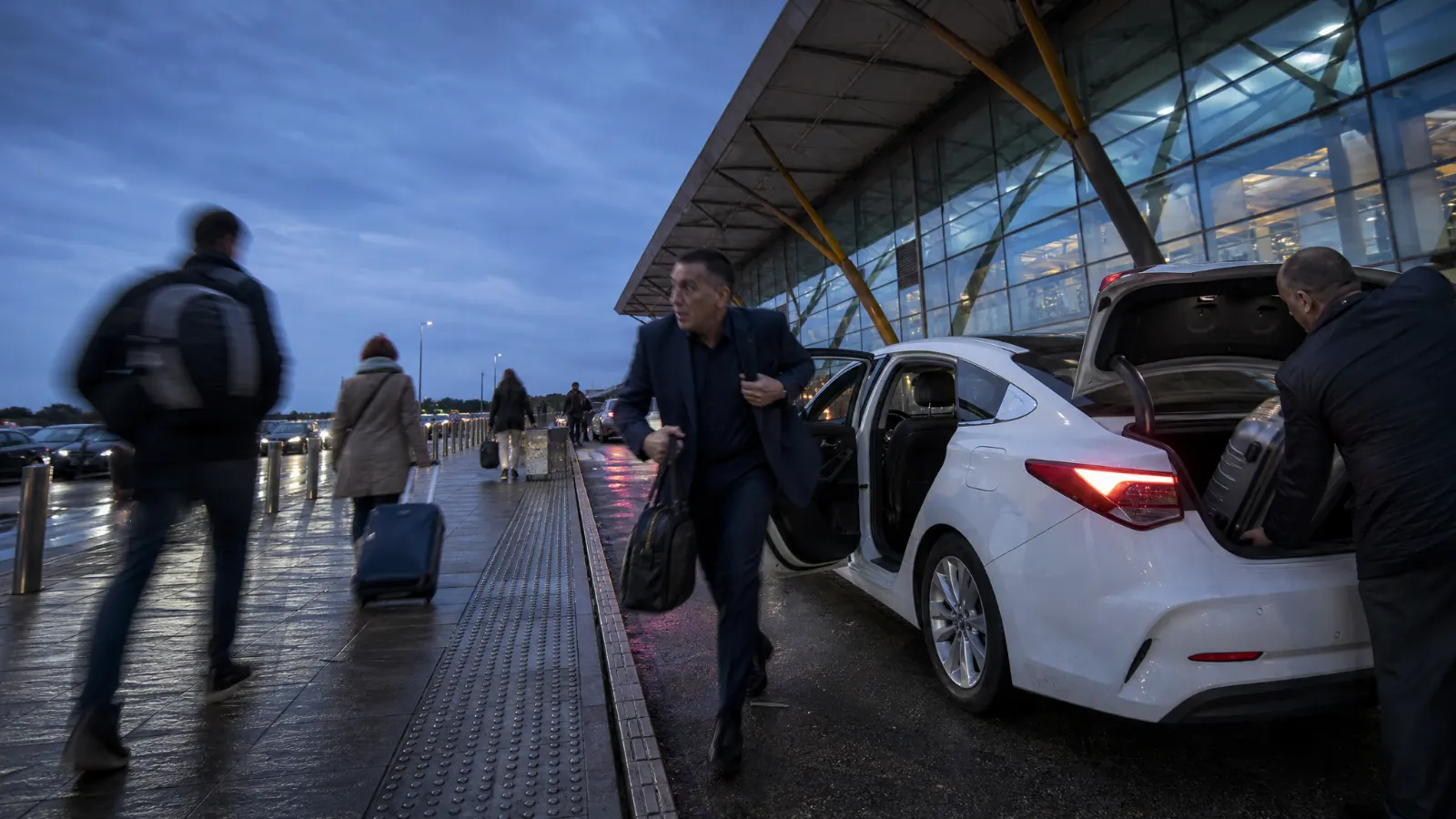
For decades, people got to the airport by private car, by bus or by taxi, on roads that are now part of the network of motorway approaches. In the late 1990s the metro arrived, with línea 8, and later the Cercanías (commuter rail) train to T4. Even so, the taxi is still the most direct option when you are travelling with luggage, in a group or at times when there is no public transport. We go through all the alternatives in the ways to get to Barajas Airport.
Today we cover the journey between the airport and Madrid, its districts and the towns of the region every day, with official taxis and a fixed fare by zone: from inside the M-30, €33 to any terminal; the other prices are under fares. If you are landing in Madrid, we will be waiting for you with an airport pickup: with your flight number we check the terminal and confirm the meeting point.
If you have a flight coming up, you can book your taxi to Barajas in advance and arrive with time to spare: 2 hours ahead for European flights and 3 for international ones.
Almost a century of airport, just a taxi ride away
Official taxi to T1, T2, T3 or T4, 24 hours a day and at a fixed fare by zone. Book free in three steps.
Fixed fares
Airport taxi from your area
- Interior M-30 €33
- Torrejón de Ardoz €30
- Alcobendas €33
- San Sebastián de los Reyes Pueblo €33
- Alcalá de Henares €53
- Getafe €53
- Leganés €53
- Majadahonda €53
- Las Rozas de Madrid €58
- Móstoles €63
- Alcorcón €63
- Fuenlabrada €63
Need a taxi to the airport?
Instant fixed price. No sign-up.
- Journey
- When
- Your details
We can't find it on the list.
Call or message us and we'll give you a price straight away.
Terminal · Madrid-Barajas
Your fixed price
Passengers
Suitcases
Your fixed price
Booking received!
We'll confirm your booking by phone shortly. If it's for less than 2 hours from now, please call us directly.
Reference
Your fixed price