
Madrid-Barajas Airport fun facts you may not know
Falcons guarding the runways, an award-winning bamboo ceiling, a train under the runway and a historic garden very close to the terminals: the side of Barajas you do not see.
Published on 22 May 2019 Updated on 1 November 2026 6 min read
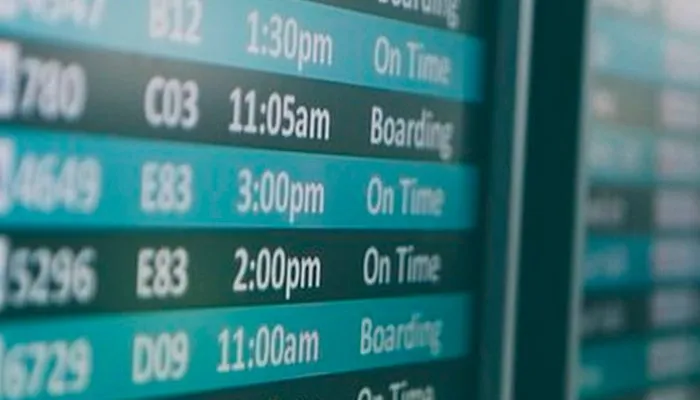
Madrid-Barajas Airport hides quite a few curiosities: it uses falcons and other birds of prey to keep the runways clear of birds, its T4 has a bamboo-clad roof that won one of the most prestigious architecture prizes in the world, and its satellite terminal is linked to the main building by a train that runs under the runways. Add to that a three-letter code every traveller has seen on their suitcase, a runway system that changes with the wind and a historic garden very close to the terminals.
If you pass through Barajas often, you have probably seen many of these things without noticing. Here are the most interesting ones.
One name, two codes and a single commercial airport
MAD and LEMD
The three letters you see on your luggage tag, MAD, are the airport's IATA code, the one used by airlines and travel agents. Pilots and air traffic controllers use another one, the four-letter ICAO code: LEMD. The initial “LE” is what identifies Spanish airports in that system.
The Adolfo Suárez name
Since 2014, the airport has been named after Adolfo Suárez, the first prime minister of Spain's democracy. The “Barajas” part remains after the former municipality where it was built, now a district of Madrid. We look at how it got here in the history of Barajas Airport.
It is not Madrid's oldest airfield
Although it is the region's major airport, Barajas is not the oldest: that title goes to Cuatro Vientos, whose origins date back to 1911. It no longer has commercial flights, as we explain in how many airports there are in Madrid.
Barajas in four curious facts
Falcons on guard
Falconers with birds of prey scare off flocks that could cross the path of aircraft.
Bamboo ceiling
T4's undulating roof is lined with bamboo slats.
A train under the runways
An automatic underground train links T4 with its satellite, T4S.
Runways by the wind
The four runways are used in one configuration or another depending on the wind direction.
Architecture: T4, an award-winning terminal
T4, opened in 2006, is the work of British architect Richard Rogers's practice together with Madrid-based Estudio Lamela. That same year it won the Stirling Prize, one of the most highly regarded architecture awards, something unusual for an airport.
Two details make it unmistakable. The first is its undulating roof, supported by large tree-shaped structures and lined inside with bamboo slats, which let natural light in through skylights. The second is the colour gradient of that steel structure, which changes shade along the length of the building. It is not just for looks: it helps you find your way inside such a long terminal.
What happens on the runways
Falconry against the danger from birds
Bird strikes are one of the classic risks in aviation, especially during take-off and landing. Barajas, like other major airports, has a wildlife control service that uses trained falcons and other birds of prey: their mere presence makes flocks avoid the runway area. It is a traditional, effective and animal-friendly method.
Four runways, two configurations
The airport has four runways arranged in two parallel pairs. Depending on the wind direction, it operates in “north configuration” or “south configuration”, which changes which runways are used for take-off and which for landing. That is why, from the window, the plane sometimes takes off or lands in very different directions on different trips.
A train that crosses under the airfield
T4S, the satellite terminal where many long-haul flights board, is separated from the main building by the runways. Passengers reach it on an automatic, driverless underground train after going through security. If you are boarding there, allow for that journey, and if you are unsure of your terminal, see which Barajas terminal do I need.
Barajas, the district that gives the airport its name
Few travellers know that, next to the terminals, the old village of Barajas keeps its old town with its main square. And in the same district, in Alameda de Osuna, is the El Capricho park, one of the most beautiful historic gardens in Madrid, with its palace, its maze and its ponds. A good idea if you have a few free hours before a flight or on a layover; for longer plans in the city, see how to make the most of a 24-hour layover in Madrid.
A hub between continents
Barajas is one of the major connecting points between Europe and Latin America. Many of the travellers you pass in T4 do not stay in Madrid: they are simply changing planes. That is why the same screens mix destinations such as Bogotá, Lima or Buenos Aires with European capitals and Spanish cities.
Go and discover it: by taxi to the door
If you are flying or want to explore T4 at your leisure, a taxi drops you at the departures door of any terminal. We work with a fixed fare by area: €33 from inside the M-30, and the other prices on our fares page. You can book your airport taxi in advance and, on the way back, request a pickup at Barajas by giving your flight number.
Setting off on a trip from Barajas?
Book your taxi to any terminal with a fixed price by area. A 24-hour service, every day.
Fixed fares
Airport taxi from your area
- Interior M-30 €33
- Torrejón de Ardoz €30
- Alcobendas €33
- San Sebastián de los Reyes Pueblo €33
- Alcalá de Henares €53
- Getafe €53
- Leganés €53
- Majadahonda €53
- Las Rozas de Madrid €58
- Móstoles €63
- Alcorcón €63
- Fuenlabrada €63
Need a taxi to the airport?
Instant fixed price. No sign-up.
- Journey
- When
- Your details
We can't find it on the list.
Call or message us and we'll give you a price straight away.
Terminal · Madrid-Barajas
Your fixed price
Passengers
Suitcases
Your fixed price
Booking received!
We'll confirm your booking by phone shortly. If it's for less than 2 hours from now, please call us directly.
Reference
Your fixed price